Trump's Energy Ceasefire Falters as Russian Strikes Continue and Ukraine Hits Yandex Data Centres
Russia struck a Kharkiv power plant hours after Donald Trump announced an energy ceasefire, while Ukrainian drones knocked out three Yandex data centres in four days. Cloudflare Radar data analysed by Valdrans shows traffic from Yandex's network falling in step with each strike, collapsing by about 94% on 11 October.
By Valdrans Editorial Team
8sources7publications
Russia struck a power plant in Kharkiv on Sunday, hours after Donald Trump announced that Moscow and Kyiv had agreed to stop attacking each other's energy infrastructure. Inside Russia, meanwhile, Ukrainian drones had spent four days knocking out data centres run by Yandex, the technology group often described as Russia's Google.
Cloudflare Radar data analysed by Valdrans shows traffic from Yandex's network falling in step with each strike, before collapsing by about 94% on 11 October.
A ceasefire announced, then a power plant hit
Trump announced the "energy ceasefire" on Truth Social on 11 October, saying it was effective immediately and that "both parties have agreed". As Valdrans reported earlier on Sunday, Kyiv appeared to learn of it from the post. Volodymyr Zelenskyy said Ukraine would observe a halt if Russia did, and had already offered to stop striking Russian refineries if the Kremlin stopped attacking Ukraine's grid.
Hours later, Russia hit Kharkiv's CHP-5 power plant. Zelenskyy said the strike came after Trump's announcement, and that Russia had carried out more than 200 strikes on Ukraine's power generation and transmission during the week. Moscow had not confirmed the agreement at the time of publication.
The announcement came two days after Trump said Putin had agreed to supply Russian diesel to world markets. Part of that supply depends on the condition of Russia's refineries, which have been a prime target for Ukrainian drones throughout 2026.
Civilians in the line of fire
Later on Sunday, a Russian missile hit a grocery store in the suburbs of Kharkiv, killing three people and injuring nine, including two children, according to Ukrainian authorities.
For civilians, damage to power stations means more than blackouts. Heating, hospitals, mobile networks and water supplies all depend on the grid, and winter is weeks away.
Three Yandex data centres in four days
Over the same period, drones hit three Yandex data centres in western Russia:
Sasovo, Ryazan region (night of 7 to 8 October). Yandex said the site was "seriously damaged" and completely shut down. Reuters reported that it houses two of the three supercomputers the company uses to develop its AI models.
Kaluga region (9 October). Yandex said part of the site's infrastructure was out of service.
Vladimir region (11 October). Yandex said drone damage forced a complete shutdown of the data centre. No one was hurt, but some of its services were unavailable.
In its own statement, Yandex warned customers that it was "very difficult to say" when the equipment would be running again. It listed the kinds of services affected: navigation and traffic, music and video, grocery ordering and the business tools companies use to take orders.
That list shows why the strikes matter beyond Yandex itself. Data centres sit underneath payments, logistics, cloud software and AI, so taking them offline disrupts far more than the buildings.
What the traffic data shows
Cloudflare publishes measurements of the traffic it sees from individual networks through its Radar service. Valdrans examined four weeks of hourly Radar data for AS13238, Yandex's main network, and AS200350, Yandex Cloud.
Against its average for 14 to 30 September, traffic from Yandex's main network:
fell by about a quarter on 8 October, the day of the Sasovo strike;
was about 35% below normal on 9 and 10 October, after the Kaluga strike;
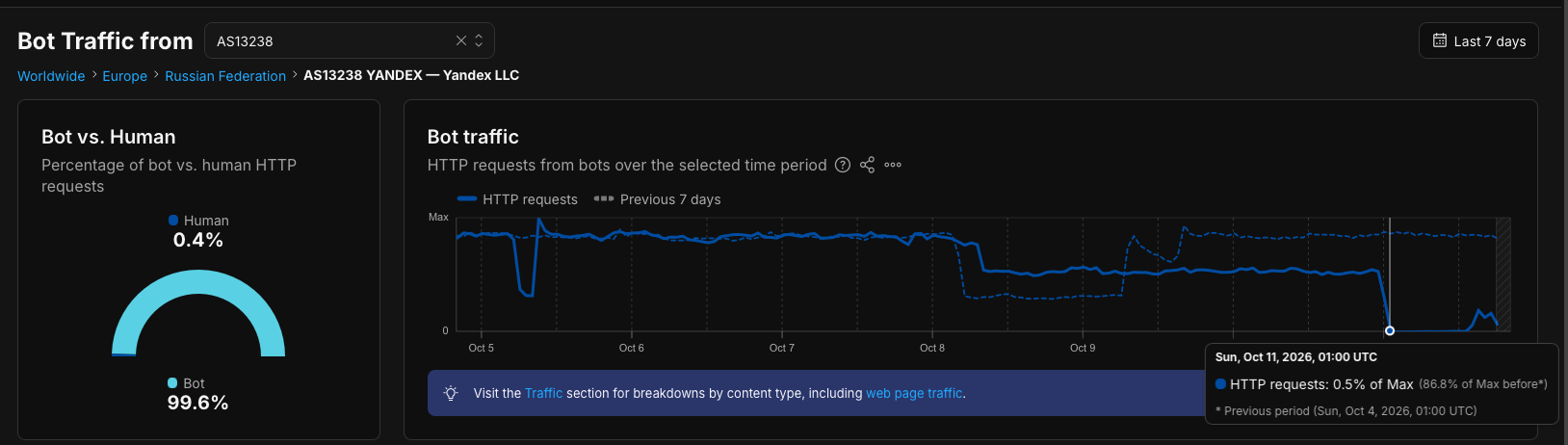
collapsed by about 94% on 11 October, the day the Vladimir site was shut down.
Figure 1: Automated traffic from Yandex's network falls to almost zero
Figure 1. Bot HTTP requests from Yandex AS13238 as a share of the period's maximum; the dashed line is the previous week. At 01:00 UTC on 11 October the reading was 0.5%, against 86.8% at the same time a week earlier. Source: Cloudflare Radar (CC BY 4.0).
At 01:00 UTC on 11 October, automated requests from Yandex's network were at 0.5% of the chart's maximum, against 86.8% at the same hour a week earlier.
That needs reading carefully. Cloudflare classes about 99.6% of Yandex's traffic as automated, and most of it is legitimate: Yandex runs one of the world's largest search engines, and its crawlers fetch web pages around the clock. Some commentators have described the fall as Russian disinformation bots going quiet. The data does not show that. It shows Yandex's own systems going offline.
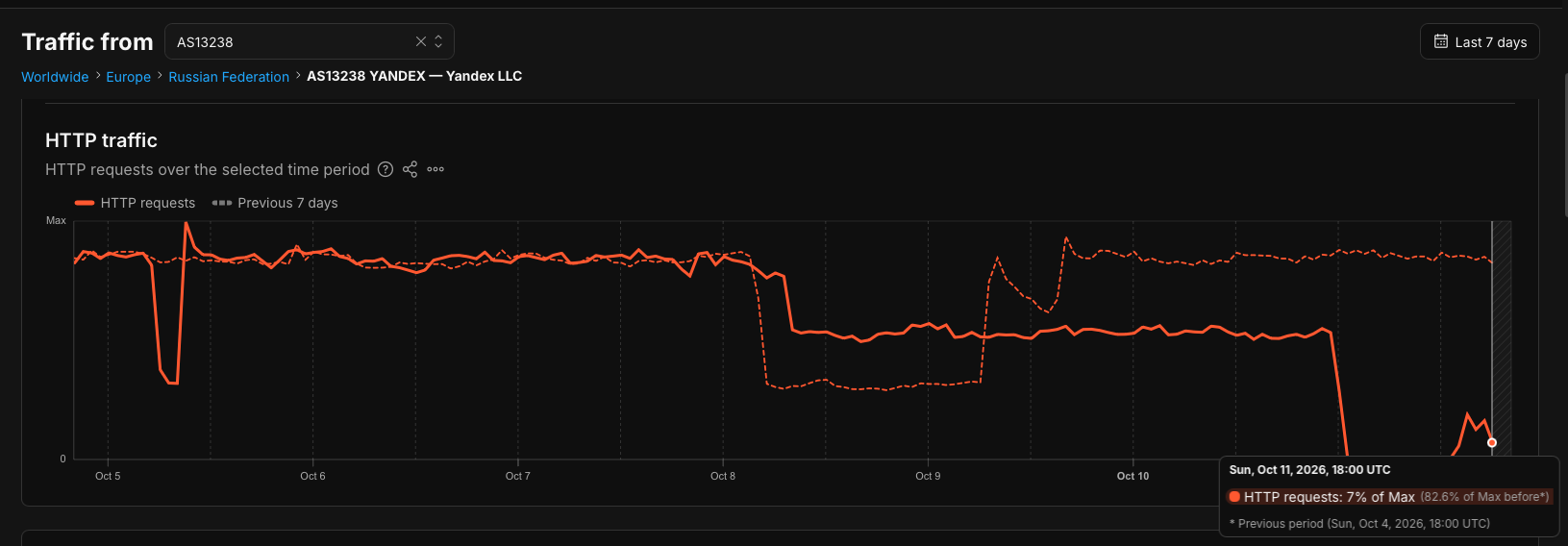
Figure 2: Total traffic follows the same path
Figure 2. All HTTP requests from Yandex AS13238 as a share of the period's maximum; the dashed line is the previous week. At 18:00 UTC on 11 October the reading was 7%, against 82.6% at the same time a week earlier. Source: Cloudflare Radar (CC BY 4.0).
Because Yandex's traffic is almost entirely automated, its total traffic tracks its bot traffic closely. The clearer sign that the damage went beyond search crawlers is in two other measurements. On 11 October, traffic that Cloudflare classes as human was down about 90% against its September average, and traffic from Yandex Cloud, which serves the company's business customers, was down about 82%.
Both charts also show a dip a week earlier. On 1 October traffic from Yandex's main network fell by about half before recovering within two days, and no cause was reported. That episode looked different: it affected only automated traffic, left human and cloud traffic untouched, and reversed quickly. The October 8 to 11 decline deepened with each strike, hit all three measures, and had not recovered by the evening of 11 October.
Radar data can show how much traffic fell and when. It cannot show which buildings were responsible, or prove the strikes caused every part of the decline. But the timing matches the reported attacks day by day.
Russia's AI ambitions are exposed
The loss of Sasovo could matter most. Training large AI models takes specialised hardware, a great deal of electricity and purpose-built data centres. Yandex has spent heavily on its own models, including YandexGPT, and two of the three supercomputers it uses for that work are reported to be at the Sasovo site.
It has not been confirmed whether any of those machines were destroyed rather than shut down. Data centres can go offline without their equipment being wrecked, and large companies usually keep backups and spare capacity elsewhere. Yandex has said only that it is still assessing the damage.
From refineries to data centres
Ukraine has spent most of 2026 hitting Russia's oil industry. By July its drones had cut Russian refining to its lowest level since 2005, with at least 24 of the country's 34 refineries hit, and Moscow had banned most fuel exports in response.
The Yandex strikes take that campaign into a new kind of target. Refineries produce the fuel Russia's army runs on. Data centres mostly serve civilians and businesses, though some may also run government or defence work. Under international humanitarian law, a facility's economic value alone does not make it a lawful target: what counts is whether it makes an effective contribution to military action, the harm expected to civilians and the precautions taken.
Russia has fought its own campaign in the digital space for years, including through state-linked hacking groups such as NoName057(16), whose alleged organisers Valdrans has reported on. What changed this week is that the damage to Russia's digital economy was done with drones.
Can the ceasefire hold?
Trump's announcement is meant to stop part of this exchange. Several questions are still open:
The terms have not been published, and Russia has not confirmed it signed up.
There is no agreed way to check whether either side is complying.
The Yandex strikes began on the night of 7 October, before the announcement, so they were not a response to it.
An agreement on energy infrastructure may not cover data centres at all.
The week showed both sides able to reach infrastructure far from the front line: Russia against Ukraine's grid, Ukraine against Russian refineries and now its data centres. A ceasefire limited to energy would leave much of that untouched, and on its first day it did not stop the strike on Kharkiv.
Method: Valdrans analysed hourly Cloudflare Radar HTTP traffic data for AS13238 (Yandex) and AS200350 (Yandex Cloud) from 13 September to 11 October 2026. Changes compare daily averages with the 14 to 30 September average. Figures for 11 October cover the period up to 19:00 UTC. The screenshots were taken from Cloudflare Radar's public charts.
Stay informed
Create a free Valdrans account
Track your reading, save your search history, and use the personal dashboard. Upgrade anytime for real-time articles and watchlist alerts.